

Chronic shoulder pain and stiffness can make even simple tasks — reaching for a shelf, brushing your hair, or sleeping on your side — difficult. When shoulder arthritis or severe joint damage no longer responds to conservative treatment, shoulder replacement surgery can restore function and significantly reduce pain.
What Is Shoulder Replacement Surgery?
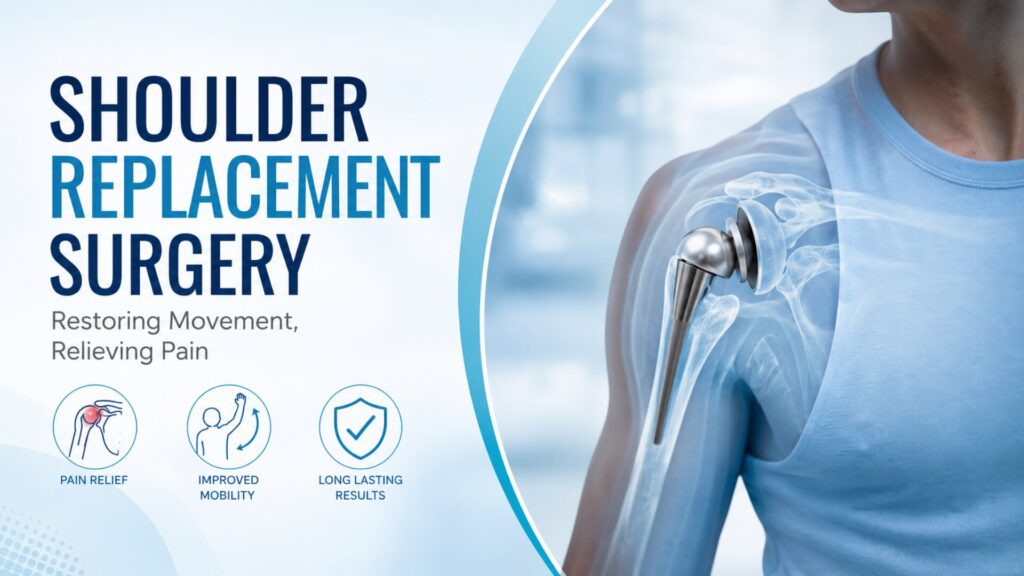
Shoulder replacement surgery involves removing the damaged parts of the shoulder joint and replacing them with artificial implants. The shoulder is a ball-and-socket joint, and depending on the extent of damage and the condition of surrounding tissue, different types of replacement may be recommended.
Who Needs Shoulder Replacement Surgery?
A shoulder surgeon may recommend shoulder replacement when a patient has:
- Severe shoulder arthritis causing persistent pain and stiffness
- Pain that limits daily activities and disrupts sleep
- Failed response to medication, injections, and physiotherapy for shoulder pain treatment
- Significant loss of shoulder motion and function
- Complex fractures of the upper arm bone (humerus) involving the joint
- Rotator cuff tear arthropathy — long-standing rotator cuff damage combined with joint arthritis
Types of Shoulder Replacement
Total Shoulder Replacement
In a total shoulder replacement, both the ball (humeral head) and the socket (glenoid) are replaced with implants that closely mimic natural shoulder anatomy. This is typically recommended for patients with shoulder arthritis who still have an intact, functioning rotator cuff.
Reverse Shoulder Replacement
Reverse shoulder replacement reverses the normal ball-and-socket configuration — placing a ball where the socket used to be and a socket where the ball used to be. This design relies on the deltoid muscle rather than the rotator cuff to power shoulder movement, making it the preferred option for patients with rotator cuff tear arthropathy or a non-functioning rotator cuff.
Partial Shoulder Replacement (Hemiarthroplasty)
Only the humeral head is replaced while the natural socket is preserved. This may be used in select fracture cases or when the glenoid is healthy.
Shoulder Replacement vs. Other Treatments
Surgery is generally considered only after conservative options have been tried, including:
- Anti-inflammatory medication and pain management
- Physiotherapy to strengthen surrounding muscles and improve range of motion
- Corticosteroid or other joint injections
- Activity modification to reduce joint strain
When these measures no longer provide meaningful relief and imaging confirms significant joint damage, shoulder replacement becomes the most effective option for restoring function.
The Shoulder Replacement Procedure
- Pre-operative assessment, including imaging (X-ray, CT, or MRI) to plan implant size and positioning
- Anesthesia — typically general anesthesia combined with a regional nerve block for pain control
- Removal of damaged joint surfaces
- Placement of the prosthetic components — total or reverse, based on pre-surgical planning
- Closure and initial assessment of shoulder stability and range of motion
The procedure typically takes between one and two hours, depending on complexity.
Recovery and Rehabilitation
Recovery after shoulder replacement is a structured process:
- Hospital stay: usually 1–3 days
- Sling support: typically worn for several weeks to protect the joint while healing
- Physiotherapy: begins early, progressing from gentle passive movement to active strengthening exercises
- Return to light daily activities: generally within 4–6 weeks
- Full recovery and return to more demanding activities: typically 4–6 months
Consistent physiotherapy is one of the most important factors in achieving good range of motion and strength after surgery.
Success Rate of Shoulder Replacement Surgery
Shoulder replacement surgery has a high success rate for relieving pain and improving function, with the large majority of patients reporting significant pain reduction and improved ability to perform daily tasks. Implant longevity continues to improve with modern materials and surgical techniques, and most patients can expect their implant to function well for 15 years or more.
Frequently Asked Questions
What is the difference between total and reverse shoulder replacement?
Total shoulder replacement preserves the normal joint anatomy and requires an intact rotator cuff, while reverse shoulder replacement changes the joint mechanics to rely on the deltoid muscle, making it suitable for patients with rotator cuff damage.
How long does shoulder replacement surgery take?
Shoulder replacement surgery typically takes one to two hours, though the exact duration depends on the type of replacement and the complexity of the individual case.
Will I regain full range of motion after shoulder replacement?
Most patients regain significant pain-free range of motion, though the exact degree depends on pre-surgical shoulder condition, the type of replacement performed, and commitment to post-operative physiotherapy.
Is reverse shoulder replacement only for older patients?
While reverse shoulder replacement is commonly performed in older patients with rotator cuff tear arthropathy, the decision is based on the condition of the joint and rotator cuff rather than age alone.
How successful is shoulder replacement surgery?
Shoulder replacement surgery has a strong track record for relieving pain and restoring function, with most patients experiencing substantial, long-lasting improvement.
Meet Your Surgeon
Dr. Amit Kumar Agarwal is a senior orthopaedic and spine surgeon practicing at Apollo Hospitals and at the Orthopaedic and Spine Clinic. With extensive experience in joint replacement, arthroscopic surgery, and spine care, Dr. Agarwal is known for combining advanced surgical techniques with a conservative, patient-first approach — recommending surgery only when it is genuinely the best path to recovery.
- Specializes in joint replacement (hip, knee, shoulder), arthroscopic surgery, and spine disorders
- Affiliated with Apollo Hospitals, one of India’s leading multi-specialty hospital networks
- Focuses on minimally invasive techniques for faster recovery and reduced post-operative pain
- Known for thorough, individualized evaluation before recommending surgical treatment
Book a Consultation
If you are dealing with shoulder arthritis or chronic shoulder pain, the first step is an accurate diagnosis. Dr. Amit Kumar Agarwal and the team at the Orthopaedic and Spine Clinic, Apollo Hospitals, offer comprehensive evaluations using advanced imaging and diagnostic tools to determine the most appropriate treatment path for you — surgical or non-surgical.
Schedule a consultation today to discuss your symptoms, get a clear diagnosis, and understand all your treatment options.