
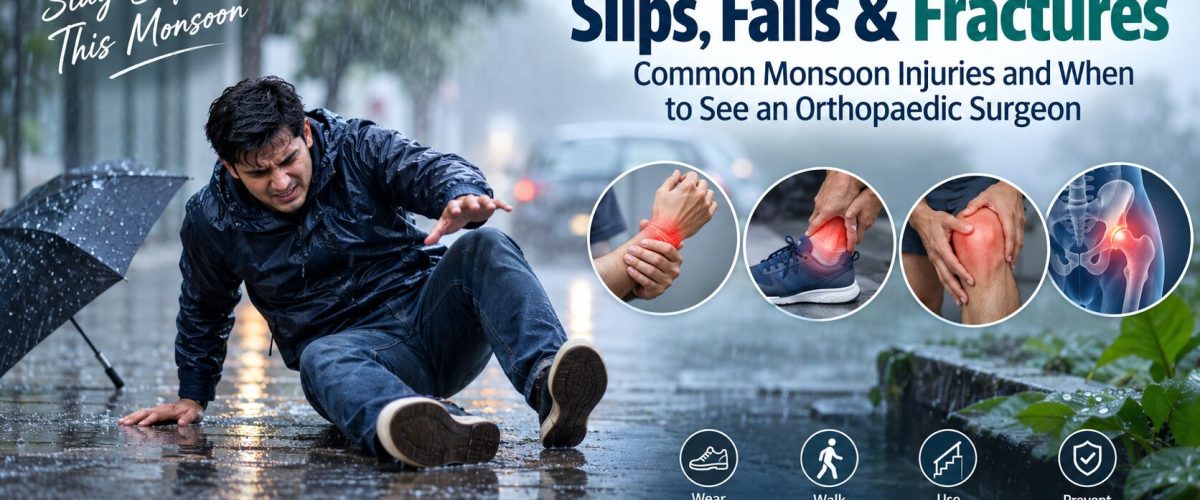
Every monsoon, orthopaedic clinics across Delhi-NCR see a sharp rise in a very specific kind of patient: someone who was simply walking to their car, stepping off a bus, or climbing a wet staircase when their foot slipped out from under them. Slips and falls are among the most common — and most preventable — causes of orthopaedic injury during the rainy season. Understanding why these injuries happen, and what to do when they do, can make the difference between a quick recovery and a long, complicated one.
Why Monsoon Increases the Risk of Falls
Rain transforms ordinary surfaces into hazards. Marble and tiled flooring, smooth footpaths, metal staircases, and even zebra crossings become significantly more slippery when wet. Add to this reduced visibility during heavy rainfall, water-logged potholes that are hard to judge, and people rushing to get out of the rain, and the risk of an awkward fall rises sharply.
Footwear plays a major role too — sandals and shoes with worn-out, smooth soles offer very little grip on wet surfaces, making a sudden slip far more likely than it would be in dry conditions.
Common Types of Monsoon Injuries
- Wrist fractures (Colles’ fracture): the most common injury from a fall, caused by instinctively putting your hand out to break the fall.
- Ankle sprains and fractures: from twisting the foot while stepping into an uneven, water-covered surface.
- Hip fractures: particularly serious in elderly patients, often resulting from a direct fall onto the side.
- Knee ligament injuries: from a sudden twist or awkward landing while trying to regain balance.
- Shoulder dislocations: common when a person falls and instinctively extends an arm to break the impact.
- Spinal injuries: less common but possible with falls from height, such as slipping on stairs.
Who Is Most Vulnerable?
- Elderly individuals, especially those with osteoporosis, where even a minor fall can cause a significant fracture.
- Children, who are often less cautious while playing or walking in the rain.
- People with pre-existing joint conditions or previous injuries, where the surrounding tissue is already weaker.
- Anyone wearing inappropriate footwear on a commute, particularly formal shoes with hard, smooth soles.
Immediate First Aid Steps After a Fall
What you do in the first few minutes after a fall can affect the outcome. If you or someone nearby experiences a fall:
- Avoid moving the injured area unnecessarily, especially if there is visible deformity or severe pain.
- Apply a cold compress to reduce swelling in the first 24-48 hours.
- Immobilise the limb if a fracture is suspected — a rolled towel or magazine can serve as a temporary splint.
- Elevate the injured limb where possible to help control swelling.
- Avoid putting weight on an injured leg, ankle, or foot until it has been evaluated.
- Do not attempt to “realign” a visibly deformed joint or bone yourself.
How to Prevent Monsoon Falls
- Choose footwear with good grip and a non-slip sole, avoiding leather or smooth-soled shoes during commutes.
- Walk at a slower, more deliberate pace on wet surfaces, especially near entrances, staircases, and crossings.
- Use handrails on staircases whenever available.
- Keep floors at home and in the office dry, using mats near entrances to absorb water.
- Carry an umbrella that doesn’t obstruct your view of the ground ahead.
- Be extra cautious around potholes and waterlogged patches, where depth is hard to judge.
When a Minor Fall Becomes a Medical Emergency
Not every fall requires a hospital visit, but certain signs should never be ignored:
- Visible deformity of a limb or joint
- Inability to bear weight or move the affected area
- Severe, worsening swelling or bruising
- Numbness or tingling below the site of injury
- Pain that doesn’t improve, or worsens, over 24-48 hours
If any of these occur, it’s important to get an orthopaedic evaluation promptly, ideally with an X-ray to rule out a fracture.
Why Timely Treatment Matters
Delaying treatment for a suspected fracture or ligament injury can lead to complications that are far harder to manage later — improper bone healing, chronic joint instability, or prolonged pain and stiffness. What might have been a straightforward cast or brace treatment if addressed early can sometimes require surgical correction if left untreated. Early diagnosis, typically through a simple X-ray or MRI where needed, allows for the least invasive and most effective treatment path.
Frequently Asked Questions
I fell but can still walk — do I still need to see a doctor? Being able to walk doesn’t rule out a fracture or ligament injury, especially in the ankle or wrist. If there is persistent pain, swelling, or reduced movement, it’s worth getting checked.
How long does a typical fracture from a fall take to heal? It varies by location and severity, but most simple fractures take 6-8 weeks to heal with appropriate immobilisation, followed by a period of rehabilitation.
Are elderly family members really at much higher risk? Yes. Reduced bone density and slower reflexes mean falls that a younger person would shake off can result in significant fractures, particularly of the hip and wrist, in older adults.
Conclusion
Monsoon falls are common, but the injuries that result from them are largely preventable with the right precautions — and very treatable with timely medical attention. Whether it’s a minor sprain or a suspected fracture, getting an accurate diagnosis early is the key to a smooth recovery.
Had a fall this monsoon? Consult Dr. (Prof.) Amit Kumar Agarwal for a prompt evaluation and the right treatment plan to get you back on your feet safely.