
Knee pain that goes on for months quietly rearranges your life. You stop taking the stairs, you skip the wedding that involves a lot of standing, and you start planning your day around a joint. When medicines and physiotherapy no longer give enough relief, the conversation often turns to surgery, and the next question is a big one: who should do it?
If you have been searching for the best knee replacement surgeon in Delhi, this guide is meant to help you think it through. It explains what the surgery involves, when it is usually recommended, what the different types are, and what to look for in a surgeon. It also describes what a knee replacement consultation with Dr. Prof. Amit Kumar Agarwal at Indraprastha Apollo Hospitals, Sarita Vihar, New Delhi, looks like.
What Is Knee Replacement Surgery?
A healthy knee works because the ends of the thigh bone and shin bone are covered in smooth cartilage. It lets the joint glide without friction. When that cartilage wears away, bone starts to rub against bone, and the result is pain, stiffness, and swelling.
People often ask whether replacement is a “big” operation. It is major surgery, performed under anaesthesia, and it deserves proper planning. At the same time, it is one of the most commonly performed joint operations worldwide, and for the right patient it can make walking, sleeping, and daily tasks noticeably easier.
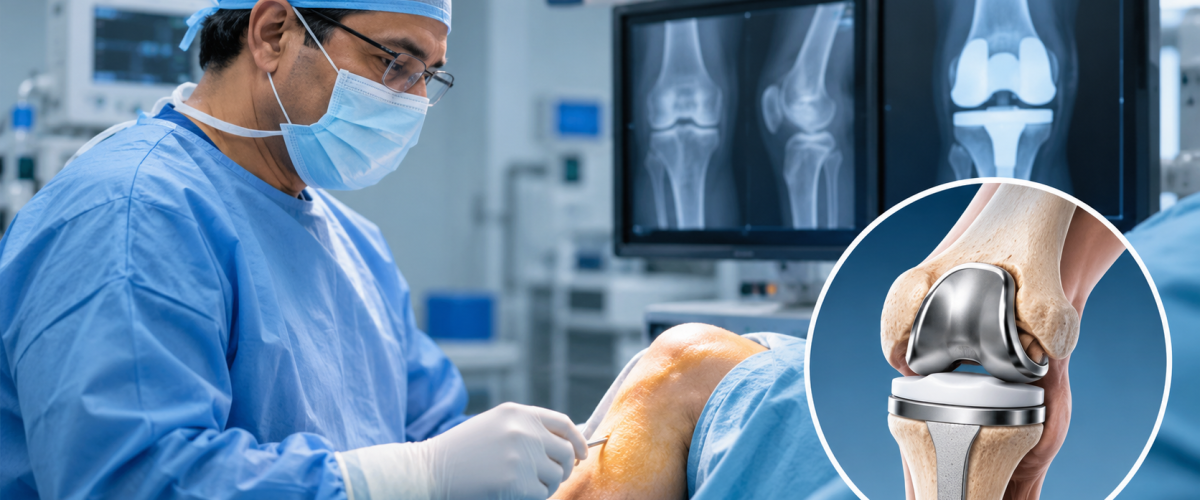
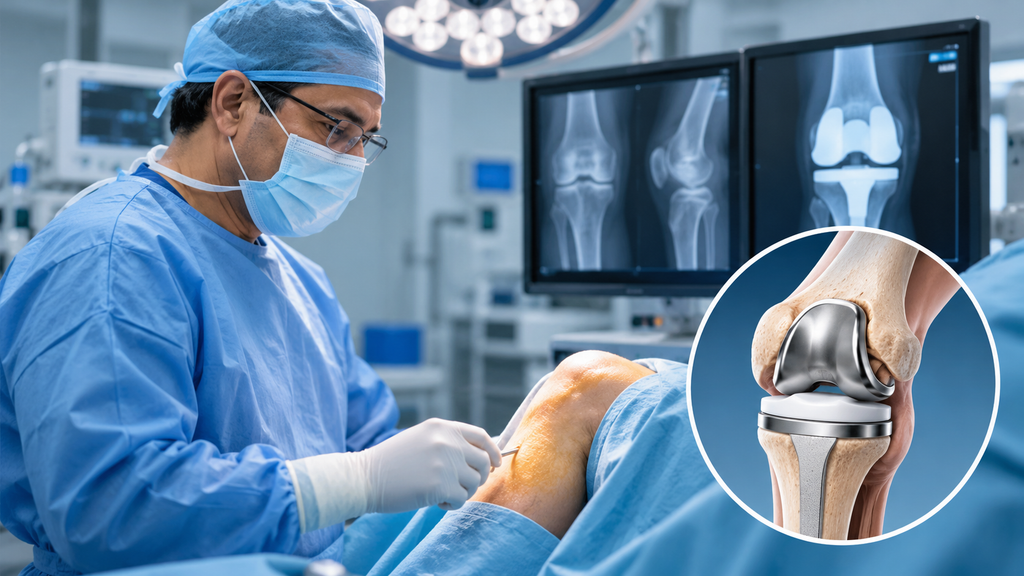
In knee replacement surgery, also called knee arthroplasty, the damaged surfaces are removed and replaced with artificial components made of metal and medical-grade plastic. The aim is to relieve pain and help the knee move more comfortably. It is not a repair of the old joint so much as a resurfacing of it, and the bones, muscles, and ligaments around the knee are still very much part of the picture.
When Is Knee Replacement Recommended?
Knee replacement is rarely the first step. Surgeons generally look at it when several things are true together: the joint has significant damage on imaging, the pain is affecting daily life or sleep, and other treatments have not given lasting relief.
Those other treatments usually include pain relief medication, physiotherapy and strengthening exercises, weight management, walking aids, and sometimes injections. If these help enough, surgery can often be postponed. If they do not, or if the knee is badly deformed, replacement becomes a reasonable conversation to have.
There is no single age at which it becomes appropriate. A person in their sixties who can barely walk to the market may be a better candidate than someone older who is managing well. The decision depends on how much the knee is limiting you, your general health, and what you hope to be able to do afterwards.
Symptoms of Advanced Knee Osteoarthritis
Osteoarthritis is the most common reason people consider knee replacement. It usually builds slowly, so many people adapt without noticing how much they have changed. These are signs that the joint may be significantly worn:
- Pain on walking, standing, or climbing stairs that does not settle with rest
- Pain at night, or pain that wakes you from sleep
- Stiffness after sitting, along with a grinding or cracking feeling
- Swelling that returns regularly
- A visible change in the shape of the leg, such as bowing inwards or outwards
- A knee that feels weak or buckles
- Difficulty with everyday tasks like getting out of a car, using an Indian-style toilet, or sitting cross-legged
Having these symptoms does not mean you need an operation. It means a proper examination and X-ray are worth doing. For many people, a clear diagnosis and a structured plan for knee arthritis treatment in Delhi starts with non-surgical care.
Types of Knee Replacement Surgery
Not every knee replacement is the same, and the right one depends on where the damage is.
Total knee replacement. All the damaged surfaces of the joint are replaced. This is the most common type and is used when arthritis affects most of the knee. You can read a full walkthrough in our guide to total knee replacement.
Partial knee replacement. If the damage is limited to one section of the knee, only that part may be replaced, leaving healthy bone and ligaments in place. It is suitable for a smaller group of patients.
Revision knee replacement. An earlier replacement that has worn, loosened, or become infected may need to be corrected with a second operation.
Techniques such as computer-assisted or robotic-assisted planning are available in some centres. Whether they are right for you is something to ask about directly. Your surgeon should be able to explain what a technique adds in your case rather than treating it as a selling point.
What to Expect Before and After Knee Replacement
Before surgery. You will have blood tests, an ECG, and imaging, and your other health conditions such as diabetes or blood pressure will be reviewed so they are well controlled. You will also talk through anaesthesia, medicines to stop or continue, and how to prepare your home. Simple things help, such as a raised seat, clear walkways, and a plan for who will be around in the first weeks.
In hospital. Most people are encouraged to stand and take a few steps with support within a day or so of surgery. Pain control, wound care, and early physiotherapy begin straight away.
After you go home. Recovery is gradual. Physiotherapy is a central part of it, and the effort you put into exercises matters a great deal. Swelling and stiffness settle over weeks, and many people continue to improve for several months. Your surgeon will guide you on when you can drive, climb stairs comfortably, and return to work. For more detail, see our page on knee replacement recovery.
Like any major operation, knee replacement carries risks, including infection, blood clots, stiffness, and problems with the implant. These will be explained to you in full before you decide.
Choosing a Knee Replacement Surgeon in Delhi
With so many options, it helps to know what to look for. These are fair questions to bring to any consultation:
- Does the surgeon examine you and review your scans before suggesting surgery?
- Are non-surgical options discussed honestly, or is surgery presented as the only route?
- Are the risks, expected recovery, and limits of the operation explained plainly?
- Is the hospital equipped for imaging, intensive care support, and rehabilitation?
- Do you feel comfortable asking questions?
Experience with joint replacement matters, but so does the quality of communication. You are going to work with this person before and after the operation, so it helps to feel heard.
Practical points matter too. Ask what the hospital’s process is for insurance approval or cashless admission, request a written estimate that explains what is and is not included, and find out how follow-up visits and physiotherapy will be arranged. Taking a second opinion before major surgery is completely reasonable, and a confident surgeon will not mind.
Consult Dr. Prof. Amit Kumar Agarwal for Knee Replacement Evaluation
If you are looking for a knee replacement doctor in Sarita Vihar, Dr. Prof. Amit Kumar Agarwal sees patients at Indraprastha Apollo Hospitals, New Delhi. A consultation involves a discussion of your symptoms, a physical examination, and a review of your X-rays or other reports, followed by a conversation about the treatment options that fit your situation. Add verified qualifications and joint replacement experience here.
You can read more on the doctor’s profile page, or learn about general orthopedic care if you are not yet sure that your knee is the problem. To arrange a knee replacement consultation in Delhi, use the appointment page or call verified phone number.
Frequently Asked Questions
How do I know if I need a knee replacement?
The need is based on a combination of pain, loss of function, and scan findings, along with how well other treatments have worked. Only an examination can confirm it.
How long does a knee replacement last?
Many implants last for well over a decade, and often longer, though this varies with your weight, activity, and bone quality. Your surgeon can give you a realistic expectation for your case.
Is knee replacement painful?
There is pain in the early days, but it is actively managed with medication and physiotherapy, and most people find it eases steadily over the following weeks.
Can I sit on the floor after knee replacement?
This depends on how your knee bends after recovery. Many patients can manage comfortable floor sitting for short periods, but deep flexion is limited by the implant. Ask about your own goals before surgery.
What should I bring to my first consultation?
Bring X-rays, MRI reports, a list of current medicines, and notes on past treatments.
Do both knees need to be replaced together?
Not always. Some patients with arthritis in both knees have one done at a time, while others may be considered for both in one sitting depending on overall health. Your surgeon will advise based on your case.
Persistent knee pain? Schedule a consultation with Dr. Prof. Amit Kumar Agarwal at Indraprastha Apollo Hospitals, Sarita Vihar, New Delhi, to discuss your diagnosis and the treatment options open to you.