
By the time most people start reading about total knee replacement in Delhi, they have already lived with knee pain for a long time. They have tried the tablets, the oils, the exercises, perhaps an injection or two. What they want now is a straight answer: what does the operation actually involve, how long will recovery take, and is it worth it?
This article walks through the procedure from start to finish. It explains who may need it, how the surgery is performed, the benefits and risks, and what recovery looks like. It also covers how to prepare for a consultation with Dr. Prof. Amit Kumar Agarwal at Indraprastha Apollo Hospitals, Sarita Vihar, New Delhi.
What Is Total Knee Replacement?
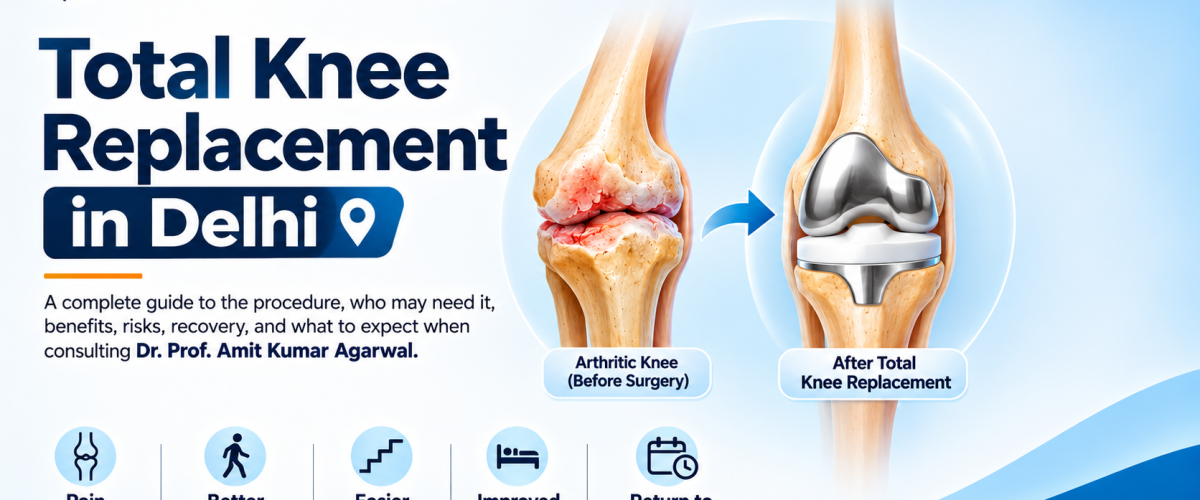
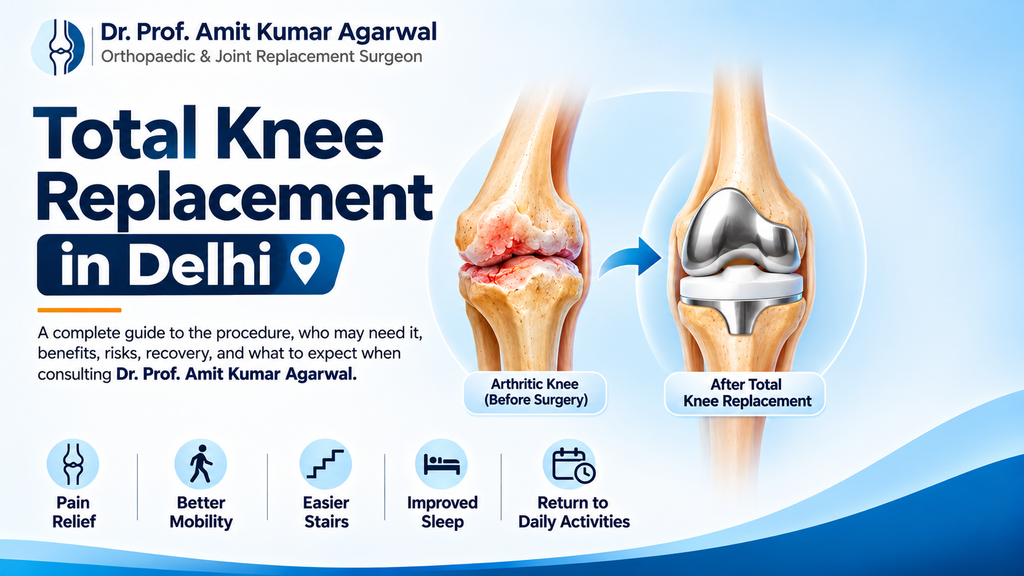
Total knee replacement, also called total knee arthroplasty, is an operation in which the worn surfaces of the knee joint are removed and replaced with implants. The knee joins three bones: the thigh bone, the shin bone, and the kneecap. When the cartilage covering them has eroded, the joint becomes painful, stiff, and sometimes misshapen.
In the operation, the damaged ends of the thigh bone and shin bone are shaped and capped with metal components, and a smooth plastic spacer is placed between them to act as the new gliding surface. The underside of the kneecap may also be resurfaced. The result is a joint that moves on clean, artificial surfaces instead of on rough bone.
Total knee replacement is one of the most commonly performed joint operations in the world, and the designs and techniques have been refined over several decades. That track record is reassuring, but it does not remove the need for individual assessment. Your age, bone quality, leg alignment, and lifestyle all affect which implant and approach make sense.
Who May Need Total Knee Replacement?
Total knee replacement is generally considered for people whose knee damage is widespread and whose symptoms have not improved enough with other treatment. The most common cause is osteoarthritis, though rheumatoid arthritis, injury-related arthritis, and some other conditions can also lead to it.
You may be a candidate if your knee pain limits walking or stairs, disturbs your sleep, or affects your ability to work or look after yourself, and if X-rays confirm significant damage. You also need to be healthy enough for surgery and anaesthesia, and willing to commit to rehabilitation.
Not everyone with an arthritic knee needs surgery. If your symptoms are mild or controlled, continuing non-surgical care may be the right choice. A consultation helps to sort out which side of that line you are on. Our overview of knee replacement surgery gives wider context on how that decision is made.
It is also worth knowing that timing matters. Waiting until the knee is severely deformed and the muscles around it have weakened can make recovery harder. At the same time, rushing into surgery before trying reasonable alternatives is not wise either. A good surgeon helps you find the sensible middle.
Signs of Advanced Knee Joint Damage
Knee damage rarely appears overnight. Look out for these patterns:
- Pain with every step, or pain even while resting
- Swelling and warmth that keep returning
- A knee that is visibly bent inwards or outwards
- Grinding, clicking, or a feeling that the knee is catching
- Shorter and shorter walking distances
- Reliance on a stick or support to move around the house
- Little or no benefit from medicines or injections that previously helped
An X-ray is the usual starting point. It can show narrowing of the joint space, bone spurs, and changes in alignment. Your surgeon will interpret the images alongside your symptoms, because how the knee looks and how it feels do not always match perfectly.
How Is Total Knee Replacement Performed?
The operation is done in a hospital operating theatre under spinal or general anaesthesia, and usually takes one to two hours. Your anaesthetist will discuss which option suits you.
In broad terms, the surgeon makes an incision at the front of the knee and moves the kneecap aside. Thin layers of damaged bone and cartilage are removed from the ends of the thigh bone and shin bone using precise cutting guides. The implant components are fitted to those prepared surfaces, either with bone cement or in a way that lets bone grow onto them. The surgeon then checks that the knee is stable, aligned, and bends and straightens smoothly before closing the wound.
Techniques differ between surgeons and centres, and some use computer-assisted or robotic-assisted systems to plan bone cuts. These tools can support accuracy, but the surgeon’s judgement and experience remain central. It is reasonable to ask what approach is planned for you and why.
Benefits and Potential Risks of Surgery
Benefits. For most patients the main gain is relief from pain, along with better mobility and an easier time with stairs, walking, and sleep. Correcting a bowed leg can also improve how you stand and walk.
Risks. Total knee replacement is a major operation, and complications, while uncommon, are possible. They include infection, blood clots in the leg veins, stiffness, persistent pain in some patients, wear or loosening of the implant over time, and injury to nearby nerves or blood vessels. Risks related to anaesthesia also apply. Your health conditions can influence the level of risk, which is why a pre-operative check is so thorough.
Results vary from one person to another, and no surgeon can promise a specific outcome. What a good surgeon can do is explain what is likely, what is possible, and what you can do to improve your chances.
Preparing your body helps. If you have diabetes, blood sugar control before surgery lowers the risk of infection. Treating dental problems, managing blood pressure, and keeping your weight steady all contribute. Strengthening the thigh muscles before the operation makes early rehabilitation smoother, and your surgeon or physiotherapist can show you suitable exercises.
Recovery and Physiotherapy After Knee Replacement
Recovery is where patient effort makes the greatest difference.
In hospital. You will usually be helped to stand and walk with a frame or crutches within a day or so. Pain relief, wound care, and measures to prevent clots begin at once. The hospital stay is typically a few days, depending on how you progress.
The first weeks. Physiotherapy focuses on bending and straightening the knee, strengthening the thigh muscles, and walking safely. Swelling and bruising are expected and can last for some weeks. Raising the leg and following your exercise schedule helps.
The months that follow. Most people move from walking aids to walking unaided, and many are back to light daily activities within a few weeks to a few months. Full recovery of strength and comfort can take several months. Your surgeon will advise on when to start driving, climbing stairs freely, and getting back to work. Our guide to knee replacement recovery has more detail.
If you used to sit on the floor or squat, ask your surgeon beforehand what is realistic with an implant. Setting expectations early avoids disappointment later.
Make the house ready before you return. A firm chair with arms, a commode or raised toilet seat, a non-slip mat in the bathroom, and a clear path from bed to bathroom make the first weeks much safer. Loose rugs and electrical wires are best moved out of the way.
How to Prepare for a Knee Replacement Consultation
A little preparation will help you get more out of your appointment with Dr. Prof. Amit Kumar Agarwal at Indraprastha Apollo Hospitals, Sarita Vihar. Add verified qualifications and joint replacement experience here.
- Bring all X-rays, MRI reports, and previous prescriptions
- List your current medicines, allergies, and any long-term conditions
- Note what you can no longer do comfortably, such as walking distance or climbing stairs
- Write down your questions in advance
- Consider bringing a family member who will be involved in your care
Read more about the arthroplasty services on offer or the doctor’s profile, then book through the appointment page or by calling verified phone number.
Frequently Asked Questions
How long does total knee replacement surgery take?
The operation itself usually takes one to two hours, though preparation and recovery time in the theatre add to the total.
When can I walk after surgery?
Most patients are encouraged to stand and walk with support within a day or so, guided by the physiotherapist.
When can I drive again?
It depends on which knee was operated on, your pain control, and how well you can control the pedals. Your surgeon will tell you when it is safe.
Will I need a second knee replacement later?
Many implants last for years, but some eventually wear and may need revision. Following your surgeon’s advice helps protect the implant.
Ready to talk it through? Book a consultation with Dr. Prof. Amit Kumar Agarwal to discuss whether total knee replacement may be appropriate for your condition.