

If you have a joint injury or chronic joint pain, you may have heard your doctor mention arthroscopic surgery as an option. This minimally invasive technique has transformed how orthopaedic surgeons diagnose and treat joint problems, allowing many patients to recover faster and with less scarring than traditional open surgery.
What Is Arthroscopic Surgery?
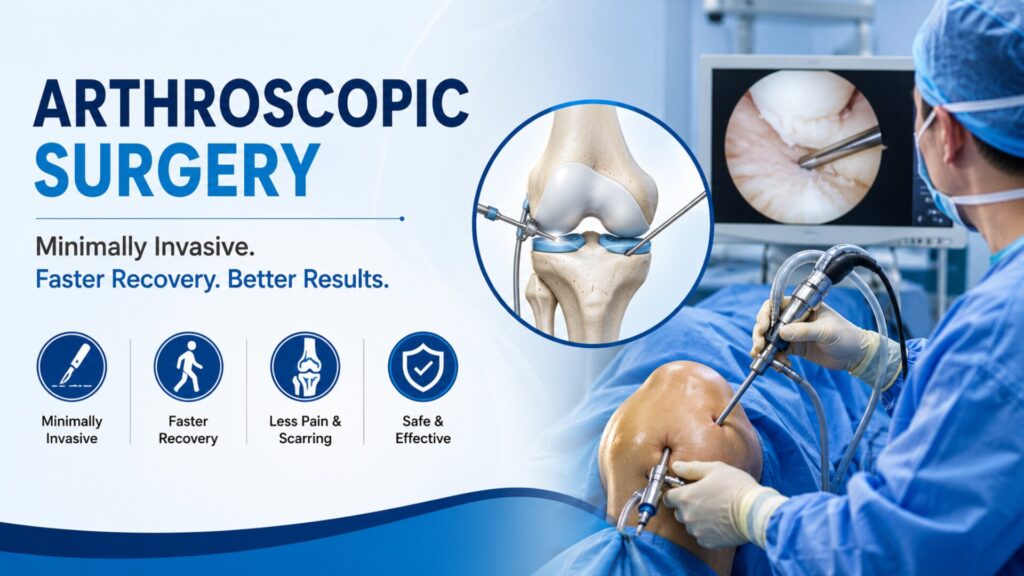
Arthroscopy is a minimally invasive orthopaedic surgery technique that uses a small camera, called an arthroscope, inserted through a tiny incision to view the inside of a joint on a monitor. Through additional small incisions, the surgeon can insert specialized instruments to repair damaged tissue without the need for a large open incision.
Because arthroscopic surgery involves smaller incisions than traditional open surgery, it generally results in less pain, reduced scarring, and a faster return to daily activities.
Which Joints Can Be Treated With Arthroscopy?
Arthroscopic techniques can be used on most major joints, though some are more commonly treated this way than others:
- Knee — for meniscus tears, ACL injuries, and cartilage damage
- Shoulder — for rotator cuff repair and shoulder instability
- Hip — for labral tears and impingement
- Ankle — for ligament damage and cartilage injuries
- Wrist and elbow — for less common but treatable joint conditions
Knee Arthroscopy
Knee arthroscopy is one of the most frequently performed orthopaedic procedures. It is commonly used to diagnose and treat:
- Meniscus tear — repairing or trimming torn cartilage that cushions the knee joint
- ACL injury — reconstructing a torn anterior cruciate ligament, often using a tissue graft
- Cartilage damage — addressing areas of worn or damaged cartilage on the joint surface
- Loose bodies — removing fragments of bone or cartilage floating within the joint
Shoulder Arthroscopy
Shoulder arthroscopy is particularly valuable for sports injury surgery and degenerative shoulder conditions. Common procedures include:
- Rotator cuff repair — reattaching torn tendons to the shoulder bone
- Labral repair — addressing tears in the cartilage rim of the shoulder socket
- Treatment of shoulder impingement and instability
Who Is a Good Candidate for Arthroscopic Surgery?
Arthroscopy may be recommended for patients who have:
- A joint injury, often from sports, that has not improved with rest and physiotherapy
- Persistent joint pain, swelling, or instability with a specific diagnosable cause
- Imaging findings (MRI or X-ray) showing a structural problem suited to arthroscopic repair
- A need for diagnostic confirmation of unclear joint symptoms
Your orthopaedic surgeon will evaluate your symptoms, examination findings, and imaging results before recommending arthroscopic treatment over other options.
Benefits of Arthroscopic (Minimally Invasive) Surgery
- Smaller incisions and less visible scarring
- Reduced post-operative pain compared to open surgery
- Lower risk of infection due to smaller wounds
- Shorter hospital stay — many procedures are done on a day-care basis
- Faster return to work and sports activities for many patients
What Happens During the Procedure?
- Anesthesia is administered (general, regional, or local depending on the joint and procedure)
- Small incisions, called portals, are made around the joint
- The arthroscope is inserted to visualize the joint structures on a screen
- Specialized instruments are used through the other portals to repair, trim, or reconstruct damaged tissue
- Incisions are closed with small stitches or adhesive strips
Most arthroscopic procedures take between 30 minutes and a couple of hours, depending on complexity.
Recovery After Arthroscopic Surgery
Recovery timelines vary depending on the joint and the extent of repair, but generally follow this pattern:
- Same-day or next-day discharge for most procedures
- Physiotherapy begins within days to restore strength and movement
- Light daily activities resume within 1–2 weeks
- Return to sports or strenuous activity: typically 6 weeks to several months, depending on the repair performed (for example, ACL reconstruction has a longer rehabilitation timeline than a simple meniscus trim)
Frequently Asked Questions
Is arthroscopic surgery painful?
Arthroscopic surgery generally causes less pain than open surgery because the incisions are much smaller. Most patients manage post-operative discomfort well with prescribed pain medication.
How long does it take to recover from knee arthroscopy?
Recovery from knee arthroscopy varies by procedure — simple meniscus trims may allow return to activity within a few weeks, while ACL reconstruction typically requires several months of structured rehabilitation.
Is arthroscopic surgery done under general anesthesia?
It can be performed under general, regional, or local anesthesia depending on the joint involved, the complexity of the procedure, and patient factors discussed with your surgeon and anesthesiologist.
Can arthroscopy be used just for diagnosis?
Yes, arthroscopy can be used diagnostically when imaging is inconclusive, allowing the surgeon to directly visualize the joint, though it is now most often used as a combined diagnostic and treatment procedure.
Will I need physiotherapy after arthroscopic surgery?
Yes, physiotherapy is a key part of recovery after most arthroscopic procedures and helps restore strength, flexibility, and joint function.
Meet Your Surgeon
Dr. Amit Kumar Agarwal is a senior orthopaedic and spine surgeon practicing at Apollo Hospitals and at the Orthopaedic and Spine Clinic. With extensive experience in joint replacement, arthroscopic surgery, and spine care, Dr. Agarwal is known for combining advanced surgical techniques with a conservative, patient-first approach — recommending surgery only when it is genuinely the best path to recovery.
- Specializes in joint replacement (hip, knee, shoulder), arthroscopic surgery, and spine disorders
- Affiliated with Apollo Hospitals, one of India’s leading multi-specialty hospital networks
- Focuses on minimally invasive techniques for faster recovery and reduced post-operative pain
- Known for thorough, individualized evaluation before recommending surgical treatment
Book a Consultation
If you are dealing with a joint injury, sports injury, or unresolved joint pain, the first step is an accurate diagnosis. Dr. Amit Kumar Agarwal and the team at the Orthopaedic and Spine Clinic, Apollo Hospitals, offer comprehensive evaluations using advanced imaging and diagnostic tools to determine the most appropriate treatment path for you — surgical or non-surgical.
Schedule a consultation today to discuss your symptoms, get a clear diagnosis, and understand all your treatment options.