
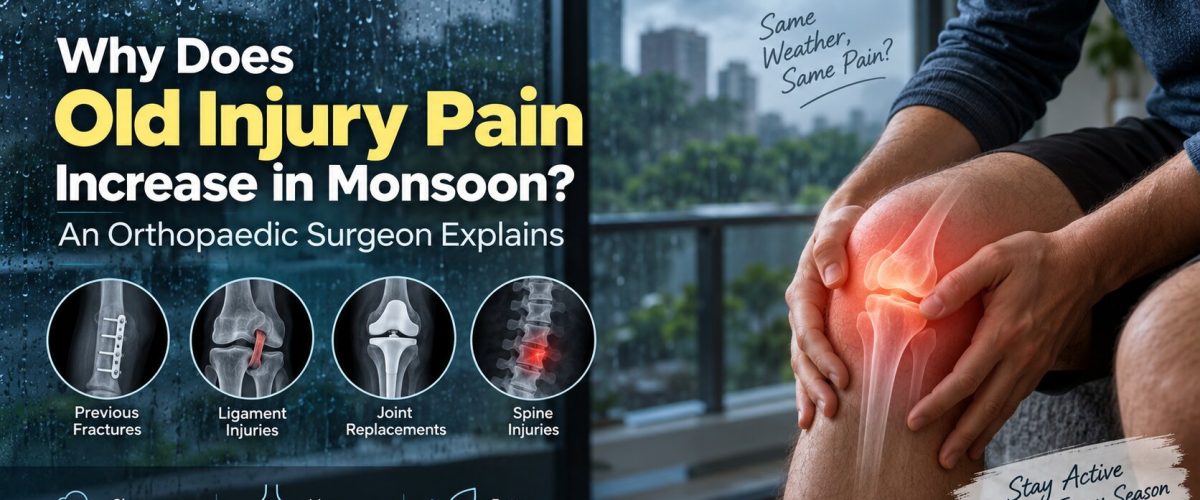
“Doctor, my old knee injury always acts up when it rains” is one of the most common observations patients share during monsoon consultations. It’s not in their heads — old injuries genuinely do become more sensitive to weather changes, and there’s a well-understood physiological explanation for why. Understanding this can help patients manage the discomfort better instead of being caught off guard by it every year.
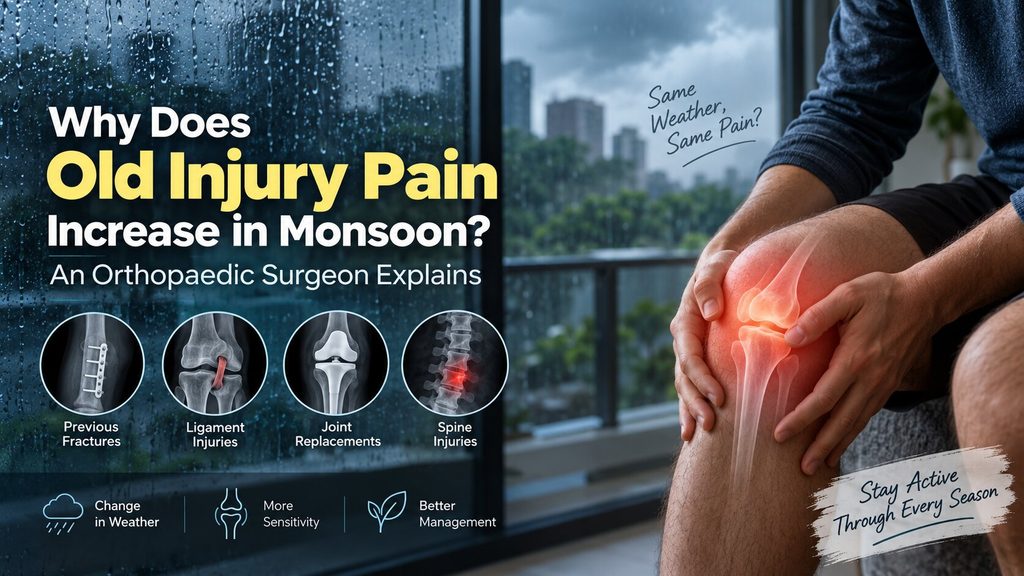
The Science: Why Old Injuries Become Weather-Sensitive
When a bone, ligament, or joint is injured and heals, the healing process often leaves behind scar tissue, altered joint mechanics, or, in the case of fractures, sometimes a slightly different bone density at the healed site. This tissue tends to have a different structure than the original, undamaged tissue — and that difference makes it more reactive to changes in the surrounding environment.
During monsoon, a drop in barometric pressure — the weight of the atmosphere pressing down on us — allows tissues in and around a joint to expand very slightly. In a joint with normal, healthy tissue, this expansion is barely noticeable. But in a joint with scar tissue, nerve sensitivity from a previous injury, or hardware from a surgery, that same small expansion can trigger a noticeably stronger pain response.
Common Old Injuries That Flare Up in Monsoon
- Previous fractures, particularly those involving joints like the wrist, ankle, or hip
- Ligament tears (such as old ACL or MCL injuries), even if they were treated conservatively without surgery
- Joint replacement surgeries, where the implant site and surrounding tissue can remain weather-sensitive
- Arthroscopic surgery sites, such as previous meniscus or rotator cuff repairs
- Old sprains that didn’t receive adequate rehabilitation at the time of injury
- Spinal injuries or previous disc-related issues
Why Scar Tissue and Implants React to Weather
Scar tissue has a different composition than the original tissue — it’s typically less elastic and has altered blood flow and nerve density. This means it can respond differently to pressure and temperature fluctuations compared to normal tissue nearby.
Metal implants used in joint replacements or fracture fixation, meanwhile, conduct temperature changes differently than surrounding bone and soft tissue. While the implant itself isn’t “reacting” to weather in a literal sense, the surrounding tissue — which may still carry some residual sensitivity from the surgery — often is.
Managing Old Injury Pain During Monsoon
1. Maintain Consistent, Gentle Movement
Keeping the affected joint moving through its regular range of motion, even gently, helps prevent the additional stiffness that inactivity adds on top of the weather-related sensitivity.
2. Apply Warmth
A warm compress or heating pad on the affected area, particularly in the morning, can help ease stiffness before you start your day.
3. Stick to Your Physiotherapy Routine
If you were given specific exercises after a fracture, surgery, or ligament injury, monsoon is precisely the time to stay consistent with them rather than skip sessions.
4. Consider Supportive Bracing for Flare-Ups
For joints prone to significant weather-related discomfort, a supportive brace during particularly bad flare-up days can help, especially during activity.
5. Manage Overall Inflammation
An anti-inflammatory diet, adequate hydration, and maintaining a healthy weight all reduce the baseline load and inflammation around previously injured joints, which can lessen how strongly they react to weather changes.
When Flare-Up Pain Needs Medical Attention
Most weather-related old injury pain is a temporary, manageable nuisance. However, you should get it evaluated if you notice:
- Pain that is significantly more severe than your usual weather-related discomfort
- New swelling, redness, or warmth around a previously injured or operated joint
- Reduced range of motion that doesn’t improve with your usual management
- Any sensation of instability in a joint that previously felt stable
These could indicate something beyond typical weather sensitivity, such as new inflammation, implant-related issues, or a fresh injury layered on top of the old one.
Long-Term Strategies to Reduce Weather Sensitivity
While you may never fully eliminate weather-related sensitivity in a previously injured joint, consistent strengthening of the muscles around it, maintaining a healthy weight, and staying generally active year-round all help reduce how pronounced the flare-ups become over time.
Frequently Asked Questions
Does this mean my old injury never fully healed? Not necessarily. Weather sensitivity in a healed injury is common and doesn’t automatically indicate incomplete healing — it reflects the altered tissue characteristics that are a normal part of the healing process.
Will this weather sensitivity ever go away completely? For many people, it lessens over the years as tissue continues to remodel, but some degree of sensitivity, especially around significant old fractures or joint replacements, can persist long-term.
Is it normal for a joint replacement to still ache years later during monsoon? Yes, this is a commonly reported experience and doesn’t necessarily indicate a problem with the implant, though any new or unusual pain around a replacement joint should still be evaluated.
Conclusion
If your old injury seems to have a mind of its own every monsoon, you’re not alone — and there’s a real physiological reason behind it. While you may not be able to prevent the sensitivity entirely, staying active, keeping the area warm, and maintaining your rehabilitation routine can significantly reduce how much it affects you each season.
Is an old injury bothering you more than usual this monsoon? Consult Dr. (Prof.) Amit Kumar Agarwal for an evaluation to rule out any new issues and get guidance on managing long-term weather sensitivity.